The Essential Guide to Breathing
Breathing and your nervous system
You don't decide your heartbeat, your digestion, or the width of your pupils. Breathing is the rare exception you can also run by hand, which makes it the most accessible dial you have on your own physiology. Here is what that dial actually does, and what it doesn't.
Alveos Research Reviewed for accuracy · Prof. John Dickinson, University of Kent Featuring Andrea Zaccaro, PhD
34 min read
You are, right now, breathing (mostly) without deciding to
Somewhere in your brainstem, a small knot of neurons called the pre-Bötzinger complex is firing in a rhythm it has kept without pause since before you were born. It does not need your attention, your permission, or your awareness. It will keep your lungs moving through sleep, through conversation, through the entire length of this sentence, and you will not have to spare it a single thought.
And yet, pause here for a moment and take one slow breath in through your nose, then let it out longer than you took it in. You just did something strange. You reached into a system that is supposed to be automatic and, for a few seconds, drove it yourself. Try that with your heartbeat, your digestion, or the diameter of your pupils and you will get nowhere. Breathing is the one large autonomic function that comes with a manual override.
That dual nature is the whole reason this guide exists. Breath sits on the seam between the part of your nervous system that runs itself and the part you can steer, which means it is both a readout of your internal state and a lever on it. When you are anxious, your breathing changes before you have consciously named the feeling. And when you deliberately change your breathing, some of that internal state changes with it. Neither direction is magic. Both are mechanism, and the mechanism is now reasonably well understood.
The trouble is that the internet's version of this story has been sanded down into slogans. "Reset your vagus nerve." "Activate rest-and-digest." "One breath to instant calm." Each of these has a real finding buried somewhere underneath it, and each has been stretched past what the evidence can hold. This guide is an attempt to give you the accurate version, detailed enough to be useful, honest enough that a physiologist would not wince, and to be specific about where the science is solid, where it is promising, and where it simply runs out.
We will build it in order: first the nervous system itself, then why breath reaches it, then the mechanisms, then the techniques (graded by how much evidence actually stands behind them), and finally the uncomfortable parts, when breathing is not the answer, and when a breathing pattern is itself the problem.
What your nervous system actually is (and what it isn't)
Start with the geography. Your central nervous system is your brain and spinal cord, the headquarters. Everything branching out from there into the body is your peripheral nervous system, and it splits along a line worth remembering. One half is the somatic nervous system: the wiring you command on purpose, the nerves that fire when you decide to raise your hand. The other half is the autonomic nervous system, or ANS, the wiring that manages the machinery you never think about. Heart rate. Blood pressure. Digestion. Sweat. Pupil size. Airway tone. Arousal. Recovery.
Breathing is the hinge between these two halves. Its default is autonomic; its override is somatic. Hold that thought. It is the pivot the entire guide turns on.
Figure 1, Where breathing sits in the nervous system

The hinge. Breathing is the only major autonomic function with a somatic override, the reason it can act as both a window into your state and a handle on it. The enteric branch (the gut's own network) is left off for clarity.
Now to the part everyone gets wrong. The autonomic system has three divisions, not two: the sympathetic, the parasympathetic, and the often-forgotten enteric, the semi-independent network embedded in your gut. But the popular story reduces the whole thing to a single seesaw: sympathetic is the gas, parasympathetic is the brake, and your day is a tug-of-war between them, with calm as the goal and stress as the enemy.
It is a tidy picture and it is misleading in three specific ways.
First, the ANS is not a stress meter. It is regulating your physiology constantly, through sleep, digestion, standing up, walking, catching a cold, paying attention, recovering from a workout, feeling an emotion. Stress is one context among many. Treating the autonomic system as a dial that only points from "calm" to "stressed" throws away almost everything it actually does.
Second, the two branches are not simple opposites. They frequently push organs in different directions, yes. But they can also activate together, withdraw independently, and move in different directions in different organs at the same time. High performance, in particular, does not come from pinning yourself to one end. It comes from being able to shift smoothly between activation and recovery as the moment demands, which is a very different goal from "stay calm."
Third, the branches are not the point of control. They are the output. You do not have a lever labelled "parasympathetic." What you have is a set of behaviours (how you move, where you put your attention, and above all how you breathe) that nudge those outputs. Breath is the most direct of those behaviours, which is exactly why it is worth understanding in detail rather than in slogans.
Why breathing is the way in
If the autonomic system is mostly sealed off from conscious control, why is breathing the exception? The answer is architectural. Breath is driven by that brainstem rhythm generator, but it is also wired to your cortex (the thinking, deciding part of your brain) through a separate set of pathways that let you take over on demand. You have two hands on the same wheel: an automatic pilot and a manual one, and you can switch between them mid-sentence.
This gives breath four properties that no other autonomic signal has all at once, and together they are the reason a company can be built around it, a practice can be taught around it, and a wearable can measure it:
It is continuous. You take somewhere between 17,000 and 24,000 breaths on a day of low-to-moderate activity, awake and asleep, with no gaps. There is always a signal to read.
It is measurable. Rate, depth, the ratio of inhale to exhale, the route (nose or mouth), the smoothness of the waveform, all of it can be captured, and increasingly without a chest strap or a clinic.
It is coupled to state. Breathing both reflects your autonomic state and influences it. The coupling runs in both directions, which is what makes it useful rather than merely descriptive.
It is trainable. Unlike a one-off measurement, a breathing pattern is a skill. It can be practised, changed, and, as we will see, sometimes needs to be.
Notice the careful phrasing on the third point. Breathing is coupled to autonomic regulation. It does not control the nervous system, and it is not a direct readout of it, a distinction we will keep returning to, because it is the line between an accurate claim and a marketing one. Breath is a lever with real leverage and real limits. The rest of this guide is about locating both.
"Breath gives you rare voluntary access to systems that are mostly automatic."
Principle The single most defensible sentence about breath and the nervous system, and the frame for everything that follows.
The three ways a breath reaches your brain
When a slow, deliberate breath changes how you feel, it is not doing one thing. It is doing at least three, along three different routes, and they overlap in the parts of the brain that matter most. Andrea Zaccaro, a cognitive neuroscientist at the University of Chieti-Pescara whose 2018 review remains one of the most-cited maps of this territory,1 laid the pathways out cleanly when he joined the Alveos podcast. It is worth walking each one.
Figure 2, Three routes from a single breath

Three routes, one action. A single slow nasal breath travels bottom-up through the vagus nerve (B), up the nasal-olfactory pathway (A), and top-down through the attention you pay to it (C). They converge on overlapping brain networks, which is likely why the effect is larger than any one route would predict.
Route A: The stretch in your lungs (bottom-up)
Wrapped around your airways are slowly adapting stretch receptors. During ordinary shallow breathing they stay fairly quiet. But when you inhale deeply and exhale slowly, you stretch the lung tissue enough to wake them up, and they send a signal up the vagus nerve toward the brainstem. As Zaccaro describes it, this acts as a kind of gentle, bottom-up vagal stimulation that ripples upward into the brain's larger resting-state networks. The deep, slow breath is, in effect, pulling on a sensory cord that runs from your lungs to your head.
This is the mechanism doing most of the work behind "slow breathing feels calming", but notice what it is not. It is not you flipping a parasympathetic switch. It is a stretch signal, travelling a real nerve, producing a graded effect. Which brings us to the nerve itself, and the biggest misconception attached to it.
What's accurate. The vagus is the body's largest cranial nerve and its main brain-body conversation line. Roughly four-fifths of its fibres are afferent, carrying information from your organs up to your brain, not commands down.
What's overstated. The vagus is not a "calm button" or a "relaxation nerve." It is a two-way communication highway involved in heart rhythm, digestion, airway reflexes and visceral sensing. "Stimulate your vagus to relax" flattens a rich system into a light switch.
Route B: The nose is not just a pipe
This is the pathway most people have never heard of, and it is the one Zaccaro finds most striking. Tucked inside the roof of your nasal cavity, near the olfactory epithelium, are mechanoreceptors that respond not to smell but to air pressure. Every time you inhale through your nose, moving air presses on them and they fire, no odour required.
"These receptors respond to air pressure, even in the absence of odours. They transduce that information to the olfactory bulb, and from there to the prefrontal areas... breathing through the nose is able to modulate the frequency of oscillation in different brain areas that are not related at all to breathing."
On the record Andrea Zaccaro, PhD · cognitive neuroscientist, University of Chieti-Pescara · Alveos Art & Science of Breathing, E5
In humans, Christina Zelano and colleagues showed the striking version of this in 2016: the rhythm of nasal breathing entrains electrical oscillations in the limbic brain, and it measurably sharpens memory and the speed of recognising a fearful face, but only when people breathe in through the nose, and the effect fades when they switch to the mouth.2 This reframes the old advice about nasal breathing. Yes, the nose warms, humidifies and filters incoming air, and it releases a puff of nitric oxide that helps the airways. The plumbing benefits are real. But the nose may also be doing something more interesting: giving your breathing rhythm a direct line to the parts of your brain that handle attention and emotion. Breathe through your mouth and you don't just lose the filter. You unplug that line entirely.
Route C: The attention you pay to it (top-down)
The third route needs no receptors at all. Simply turning your attention to your breath is itself an interoceptive act, interoception being your sense of your body's internal state, the counterpart to the outward-facing senses of sight and sound. Anchoring attention on the breath quiets the mind's default wandering and pulls awareness inward, and this top-down focus overlaps in the brain with the very same networks the bottom-up stretch signal reaches. Zaccaro's own more recent work adds a lovely detail: our perception of internal signals, like the beating of the heart, sharpens during exhalation. The out-breath is not only the calming phase; it may also be the phase in which your perception of those internal signals is sharpest.
Three routes, then: a stretch, a rhythm in the nose, and an act of attention, all converging on shared territory. You do not need to feel all three to benefit from any one. But it explains why a slow nasal breath taken with attention does more than the sum of its parts, and why the instruction "breathe slowly, through your nose, and notice it" keeps reappearing across traditions that never spoke to each other.
Why the out-breath is the calming one
Put two fingers on your pulse and breathe slowly and deeply for a minute, and if you pay close attention you can feel it: your heart speeds up a little as you breathe in, and slows down as you breathe out. This is not a fault. It is one of the most elegant pieces of coupling in the whole body, and it has a name, respiratory sinus arrhythmia, or RSA.
Figure 3, Respiratory sinus arrhythmia: heart rate rides the breath
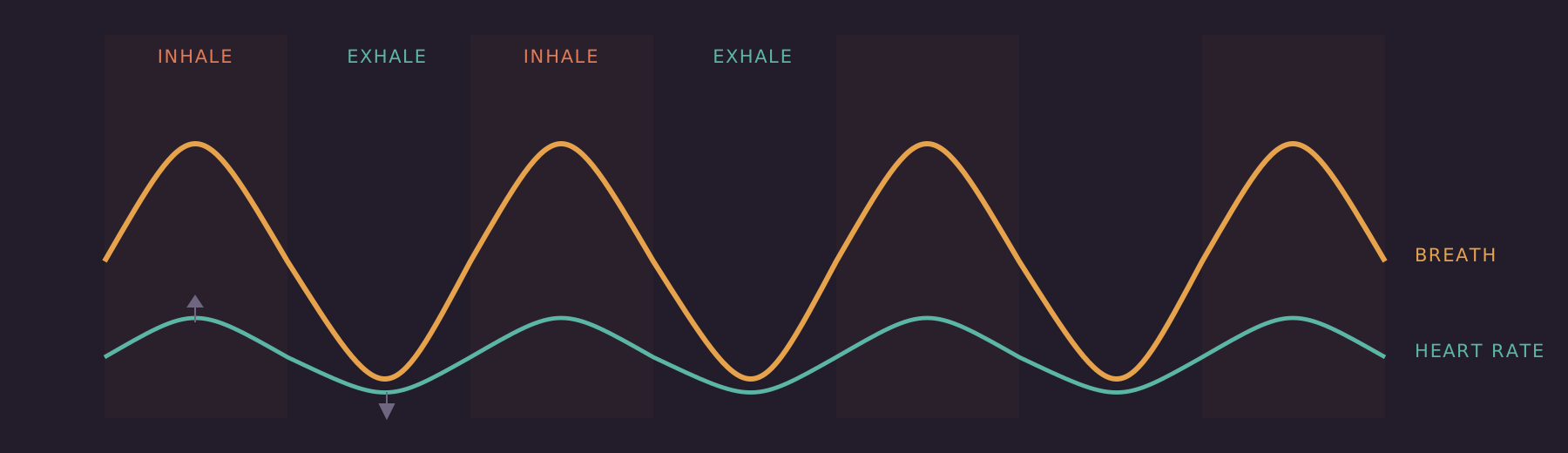
The two curves track. As you inhale, the vagal "brake" on your heart eases and heart rate climbs; as you exhale, the brake re-engages and it falls. Slow, deep breathing exaggerates this swing. A large, healthy RSA is a sign of a responsive system, not a broken one.
Here is the machinery. Your parasympathetic system, via the vagus nerve, acts as a continuous brake on your heart, holding its rate down. During inhalation, that brake is briefly released and the heart speeds up; during exhalation, the brake re-engages and the heart slows. The out-breath, in other words, is the moment the parasympathetic "brake" is doing its work. This is the physiological reason behind a piece of advice you have heard a hundred times without the mechanism: to settle yourself, make your exhale longer than your inhale. You are not performing a ritual. You are extending the phase during which the vagal brake is applied.
Andrea Zaccaro described the same loop from the cardiovascular side, how slow, deep breaths produce "a deeper reduction in heart rate during exhalation and a faster increase in heart rate during inhalation," and how this swing is itself a marker of how flexibly the cardiovascular system can adapt. John Dickinson, watching it from the athletic side, put the practical version even more plainly:
"If we breathe out nice and relaxed... that activates the part of the nervous system that helps keep everything calm. But if we breathe out too fast, that starts to impact the sympathetic nervous system, which gets us all excited and wants to increase the breathing rate."
On the record Prof. John Dickinson, PhD · respiratory physiologist, University of Kent · Alveos Art & Science of Breathing, E3
Two people, a neuroscientist and a sports physiologist, arriving at the same lever from opposite directions: the quality of the exhale is where a lot of the regulation lives. Rush it and you tip toward activation. Let it lengthen and unspool, and you engage the recovery side. It is the single most transferable idea in this entire guide, and it costs nothing to try.
What "slow" means, and the resonant pace
"Breathe slowly" is good advice made useless by vagueness. Slower than what, and how slow? The science is unusually specific here, so let us pin it down.
At rest, most adults breathe somewhere between 12 and 20 breaths a minute, a range so ordinary it is one of the four classic vital signs, sitting alongside heart rate, blood pressure and temperature. (It is also, tellingly, the vital sign clinicians most often eyeball rather than measure, which is a story for another guide.) The research literature on slow breathing generally means dropping well below that band; Zaccaro's review drew its line at under nine breaths a minute. And within the slow range there appears to be a special pace.
Figure 4, The respiratory-rate spectrum

The resonant pace. Around five to six breaths a minute, the rhythm of breathing lines up with the natural rhythm of the heart-rate and blood-pressure control loops. Breathe at that frequency and the swings reinforce each other, and heart-rate variability reaches its peak. Think of it as pushing a swing in time with its arc.
That pace, roughly five to six breaths a minute, is often called the resonance frequency. At around this rate, the oscillation of your breathing synchronises with the natural oscillation of your baroreflex, the feedback loop that manages blood pressure beat to beat. The two rhythms fall into step, reinforce each other, and heart-rate variability swings to its maximum. Paul Lehrer and colleagues built an entire, well-studied form of HRV biofeedback on precisely this effect.3 The swing metaphor is exact: push a playground swing at random and you fight it; push it in time with its arc and small efforts produce large motion.
What actually happens when people practise slow breathing at these paces? Zaccaro's review is the careful synthesis. Reading across the studies that met his bar, slow breathing was associated with measurable shifts on both sides of the mind-body ledger: increased heart-rate variability and greater parasympathetic activity in the body, alongside increased EEG alpha power and more activity in attention-related prefrontal regions in the brain, and, downstream of those, reductions in reported anxiety and stress and increases in comfort, alertness and positive mood.1 Not a cure for anything. But a real, repeatable, measurable nudge, and, importantly, a nudge you can feel for yourself in about ninety seconds.
Which is a good moment to stop reading and start doing.
An interactive pacer with all of these patterns is at the bottom of this guide, just above the footer. Pick a pattern, press start, and breathe with it.
Resonance breathing. A smooth 5.5-second inhale and 5.5-second exhale, about 5.5 breaths a minute, near the pace where heart-rate variability tends to peak. The evergreen "if you only learn one, learn this" pattern.
A pacer is a training wheel, not a treatment. If any pattern makes you dizzy or short of breath, stop and breathe normally, that is a signal, not a failure.
Which methods actually have evidence behind them
Here is where the internet is at its worst, every technique presented with equal, breathless confidence, each one a "hack" that will "instantly" do something dramatic. The honest picture has texture. Some patterns are backed by solid, repeated studies; some by a promising handful; some are mostly tradition and physiological plausibility. All of that is fine, plausible and pleasant is a perfectly good reason to breathe a certain way, as long as nobody pretends the tradition is a clinical trial. So here is the same set of techniques, sorted by how much weight the evidence can actually bear.
Technique | What it is | Best for | Evidence |
|---|---|---|---|
Resonance / slow breathing~ 5-6 breaths/min | Smooth, equal, slow nasal breaths at your resonant pace, often with HRV biofeedback. | calm · focus | Strong |
Cyclic / physiological sighdouble inhale, long exhale | Two stacked inhales through the nose, then a slow, complete exhale through the mouth. | acute stress | Strong |
Longer exhale than inhalee.g. 4 in / 6 out | Any comfortable pattern where the out-breath is meaningfully longer than the in-breath. | calm · sleep | Moderate |
Box breathing4·4·4·4 | Equal inhale, hold, exhale, hold. A steadying, structured square. | focus · steadiness | Moderate |
4-7-8 breathing4 in · 7 hold · 8 out | A slow pattern with a long hold and a very long exhale; popularised for sleep. | wind-down | Early / plausible |
Cyclic hyperventilationWim Hof-style | Rounds of fast, full breaths followed by breath-holds. An activating practice, not a calming one. | arousal · cold | Early · caution |
Buteyko / reduced breathinglight, nasal, CO2-tolerant | Deliberately gentle, low-volume nasal breathing to raise tolerance to carbon dioxide. | over-breathing | Moderate (asthma) |
How to read this. "Strong" means multiple controlled studies point the same way. "Moderate" means real support with gaps. "Early / plausible" means the physiology makes sense and small studies are encouraging, but the evidence is thin, treat these as reasonable to try, not as established fact.
The two with the firmest ground
Resonance and slow breathing earn the top grade because they are the most-studied and the mechanism is the best understood, the resonant-pace effect on HRV and the baroreflex, replicated across biofeedback research. If you learn one thing from this guide and practise it, make it this: slow, smooth, roughly equal breaths at around five or six a minute.
The surprise entry at the top is the physiological sigh, a double inhale (a second sip of air stacked on the first) followed by a long, unhurried exhale. Your body already does this spontaneously when you sob, and periodically overnight, to reinflate collapsed air sacs in the lungs. In 2023, a Stanford team led by Melis Balban ran a proper randomised comparison: five minutes a day for a month of "cyclic sighing", this double-inhale, long-exhale pattern on repeat, improved mood and lowered breathing rate more than an equal dose of mindfulness meditation.4 Of the breathwork styles they tested, cyclic sighing came out ahead. For a fast, in-the-moment reset, it is the best-evidenced tool on the list, and it takes about twenty seconds.
The steady middle
Longer-exhale patterns and box breathing both rest on solid mechanism, the exhale-lengthening, vagal-brake logic from Section 5, and the calming pull of a slow, structured, predictable rhythm, with a somewhat thinner base of dedicated trials. They are excellent, safe, sensible defaults. Box breathing's equal, four-count square is genuinely good for finding steadiness under pressure, which is why it spread from military settings into everyday use. Just resist the word "instantly." A structured breath helps you regulate; it does not teleport you into calm.
Reasonable to try, thin on proof
4-7-8 breathing is a longer-exhale pattern in a memorable costume. The long out-breath is doing the real work, and the physiology is sound, but the specific 4-7-8 protocol has little dedicated research behind its bigger claims. Fine as a wind-down ritual; not a sleep cure.
Cyclic hyperventilation, the fast-breathing-plus-holds family made famous by Wim Hof, deserves a clearer label than it usually gets: it is an activating practice. It ramps arousal up, it can produce genuinely strange and sometimes pleasant altered states, and it is emphatically not a bedtime relaxation. It also carries a real, specific hazard: never do it in or near water, or while driving, because the breath-holds can cause fainting. This is the technique on the list that most needs the caution Zaccaro raised about intense breathwork in general.
"These techniques, especially when they go deep, when they become really slow, or even faster, should be learned with care and caution, and supervised by an expert. And the idea that slow breathing is a solution to all our problems, it isn't. It has positive effects, but it's not a panacea. It should be better personalised."
The caveat Andrea Zaccaro, PhD · on why the strongest claims deserve the most scepticism
That personalisation point is the one social media flattens most often. A pattern that settles a wired, over-activated person may do nothing useful for someone who is already flat and under-aroused, for whom the right prescription might be an alerting practice, or movement, rather than more slowing-down. There is no universal breath. There is the breath that fits the person and the moment, which is precisely the thing a single viral clip cannot know about you.
When breathing is the problem, and when it isn't the answer
So far this has been a guide to using your breath on purpose. But there is a flip side that the wellness conversation almost entirely ignores: sometimes the breathing pattern itself is the thing that has gone wrong, quietly, in the background, without anyone teaching you a technique to fix it. Prof. John Dickinson has spent two decades on exactly this problem, first with British Olympic athletes and now with ordinary people, and his starting point is disarming.
"Very few of us get taught how to breathe. We're born, we start breathing, and we just keep doing it. I liken it to walking, some of us have a really efficient gait, and some of us move in a way that actually causes injury. Breathing pattern's a bit similar."
On the record Prof. John Dickinson, PhD · University of Kent
When an inefficient breathing pattern settles in and starts to cause symptoms (breathlessness that outpaces the effort, a tight chest, difficulty getting a satisfying breath, trouble recovering between efforts), clinicians now call it a breathing pattern disorder (the older term was "dysfunctional breathing"). It is genuinely common and genuinely under-recognised, in part, Dickinson notes, because the standardised tools to identify it are not widely available, so it is frequently mistaken for asthma and treated with an inhaler that cannot fix it. An inhaler opens the airways; a breathing pattern disorder is a problem of how the machinery moves, not of the airways being shut.
What a "good breath" actually looks like
Dickinson's lab used 3D motion mapping to answer a question most people never think to ask: what does an efficient breath physically do? The answer is specific. A good breath starts low, at the base of the rib cage where the diaphragm lives, and the lower ribs move outward, sideways, and forward-and-back, before the upper chest gets involved at all. Then the out-breath is slow, controlled and unforced. Set against that, here are the inefficient patterns his team sees again and again:
Apical breathing, pulling air in with the shoulders and upper chest. It looks like effort but it locks the rib cage and delivers perhaps two-thirds of the air a relaxed breath would.
Thoraco-abdominal asynchrony, the belly and the chest moving out of sequence rather than together, so parts of the rib cage never fully expand.
Breath-holding and forcing, unconsciously pausing, or shoving the air out fast. And recall the cost of that fast exhale: it nudges the sympathetic side and winds the whole pattern up.
Inconsistent depth, a small breath, a small breath, then a big compensatory gulp, never quite finding a satisfying rhythm.
Why should anyone care about a slightly inefficient pattern? Because it is not free. In Dickinson's estimate, an efficient breather spends roughly 12% of their energy on the work of breathing during hard exercise; an inefficient one, closer to 18%. That is energy stolen from the legs. Worse, when the breathing muscles get overworked, they trigger a reflex (the respiratory muscle metaboreflex) that diverts blood away from your working muscles to protect your ability to breathe, and you slow down without understanding why. Off the sports field, the toll is different: chronically breathless people build up anxiety about the breathlessness itself, and, as Dickinson has seen in his long-COVID patients, that worry loops back to make the breathing worse. The good news buried in all of this is that a breathing pattern is a skill, which means it can be retrained. The catch is that it usually takes coaching, attention and time, not a viral technique.
A necessary line. This guide is education, not medical advice, and Alveos makes wellness tools, not diagnostic ones. Breathlessness can have serious medical causes. If you have persistent or sudden shortness of breath, chest pain, breathlessness at rest, or you suspect a sleep-breathing disorder, please see a qualified clinician rather than a breathing app. Slow breathing is a lever on a healthy system, not a substitute for care.
The one habit worth stealing
Ask a breathing scientist for his own daily protocol and you might expect a regimen. Dickinson's answer is the opposite, and it is the most practical advice in this guide. He does not keep a "breathing diary" or a fixed five-minute slot, because he knows those collapse after a few weeks. Instead he attaches breathing to things he already does: a stretch, a short morning yoga sequence, even boiling the kettle becomes the cue to drop the shoulders and take a few good breaths. The lesson generalises: a breathing practice that survives is one bolted onto an existing habit, not one competing for a fresh slot in a busy day. Consistency beats intensity, and a cue beats willpower.
What your breathing does while you sleep
Roughly a third of your life, and a third of your breathing, happens while you are unconscious. The moment you fall asleep, conscious control drops away entirely and that brainstem rhythm generator takes over for the night. You would think, then, that nothing you do about your breathing could matter here. But the way you breathe by day and the shape your airway settles into by night both follow you into sleep, and this is the arena where breathing quietly does some of its most consequential work on how you feel the next morning.
Start with the route, because it is the single most searched-for question in this whole territory: nose or mouth. During the day, mouth breathing is a lapse you can catch and correct. Asleep, you cannot. And the evidence points one clear direction: mouth breathing during sleep is linked with more disrupted, less restorative sleep, with the dry mouth, the snoring, and the groggy, unrefreshed mornings that tend to travel with it. None of that is a diagnosis. It is an association, and a well-documented one, and it is precisely why so many people arrive at this subject through a very specific worry: I think I breathe through my mouth at night, and I don't know how to tell.
That "how to tell" is the genuinely hard part, and it deserves honesty. The whole problem with sleep breathing is that it happens while the one person who could observe it is switched off. The usual clues are unreliable narrators. A dry mouth on waking, a bed partner's report of snoring, tired mornings, these hint at a pattern but they miss plenty, and they cannot tell you how often, how long, or in which stages of the night it happened. Symptom checklists for nocturnal mouth breathing, when researchers have tested them, turn out to be surprisingly leaky. You are, in effect, trying to audit a process you are structurally unable to witness.
"The more relaxed our breathing is, the more likely we are to get better quality of sleep. If the breathing's erratic during your sleep, that's going to impact your quality of recovery. And I've worked with several individuals who've said, actually I'm sleeping much better now because my breathing's a bit more relaxed."
On the record Prof. John Dickinson, PhD · University of Kent
Dickinson is careful, and worth borrowing the care from. The hard causal claim, that fixing your daytime breathing guarantees better sleep, is not something the research can yet support, and he does not make it. What he offers instead is the honest, intuitive version: the more relaxed and efficient your breathing is in general, the better the odds that it stays relaxed once your brainstem takes over for the night. He has watched it play out in his long-COVID patients, some of whom reported sleeping through the night again once their breathing steadied. Anecdote, he would be the first to say, is not a controlled trial. But it points somewhere sensible.
The wide, unserved middle
Here is the part the internet handles worst. On one end sits "normal, healthy sleep breathing." On the far end sits diagnosed sleep apnea, a medical condition that belongs firmly with a clinician and a sleep study. Between those two poles is an enormous, under-mapped middle: habitual nocturnal mouth breathing, subtly disrupted patterns, the person who is not apneic but is plainly not sleeping as well as they could. Medicine has historically had little to say to that middle, and the wellness internet has filled the silence with mouth tape and confident hacks. The accurate stance is narrower and more useful. Your breathing route and rhythm at night are worth paying attention to as a wellness signal. They are not a substitute for medical assessment when something is genuinely wrong.
Where the line is. Loud habitual snoring, gasping or choking awakenings, long breathing pauses a partner notices, or heavy daytime sleepiness are not wellness territory. They warrant a proper clinical assessment for a sleep-breathing disorder. A breathing app, this guide included, is not the place to rule that in or out.
What about mouth tape, the thing half the internet is now wearing to bed? The underlying instinct, nose good, is sound, and you will remember why from the mechanisms: the nasal route conditions the air and may keep that direct line open to your attention and emotion networks even while you sleep. But taping is not a universal fix, and the caution is real, one the sleep scientist Matthew Walker has raised publicly. If you cannot comfortably breathe through your nose at night, the answer is to find out why, which can be structural or medical, not to force the mouth shut and hope. Nasal breathing is the goal; a strip of tape is one crude means to it, and not the right one for everyone.
Sleep is, in the end, the clearest case for the argument this whole guide keeps circling: the breath most worth understanding is often the one you are not awake to notice. It is continuous, it is coupled to how recovered you feel, and it is the hardest of all to observe from the inside. That is not a coincidence. It is the reason the night is where a patient, external record of your breathing has the most to offer, and the reason the question that brings people here, am I breathing through my mouth while I sleep, is a better question than it first appears.
Measuring your state, without fooling yourself
If breathing is coupled to autonomic state, can't you just measure the state directly? This is where a lot of the quantified-self world quietly overreaches, so it is worth being precise about what the popular metrics can and cannot tell you.
The headline number is heart-rate variability, the beat-to-beat variation in your heart rate, which you met earlier as RSA. HRV is a genuinely useful window: certain measures of it (RMSSD and high-frequency HRV) are widely used as indices of how much your parasympathetic system is modulating your heart. Higher generally tracks with a more responsive, better-recovered system. But HRV is also fragile in a way the ring and watch dashboards rarely admit.
Fair to say. RMSSD and HF-HRV are commonly used as indices of cardiac vagal modulation. Trends over weeks, measured under consistent conditions, can be informative about recovery and load.
Not fair to say. "HRV measures your stress." "RMSSD equals your parasympathetic tone." A single reading does not. HRV is pushed around by your breathing rate, posture, movement, sleep, illness, caffeine, alcohol and signal quality, sometimes more than by the thing you meant to measure.
Notice the awkward twist in that list: breathing rate itself moves HRV. Breathe slower and your HRV rises, which is part of why slow breathing "improves" the number, and also why HRV alone is a slippery way to infer your state without knowing how you were breathing when it was taken. The signal you are reading and the lever you are pulling are tangled together.
This is the quiet case for paying attention to breathing directly rather than only to its downstream shadows. Most wearables infer your respiration from your pulse, a clever estimate, but an estimate, derived from the heart rather than the lungs. Measuring the breath itself, continuously, captures things a heart-rate proxy cannot: the ratio of inhale to exhale, whether you are breathing through your nose or your mouth, the smoothness of the waveform, the slow drift of your baseline across a day. It is the difference between reading the effect and watching the cause. That is the specific gap Alveos One is built to close, not to diagnose anything, and not to "read your nervous system," but to make a continuous, trainable signal visible so you can notice patterns and, when you choose to, work on them. State is always inferred, never directly read. The honest promise is a better window and a gentle nudge, not a verdict.
And there is a subtler skill under all of this, one Zaccaro's interoception research points to: the goal is not to crank your bodily awareness as high as it will go. Interoception seems to have a sweet spot. Too little and emotion regulation suffers; too much, and ordinary bodily sensations can be misread catastrophically, the very loop that feeds panic. The aim is a calibrated, trainable awareness of your own signals, sitting somewhere sensible in the middle. Measurement, used well, serves that calibration. Used badly, it just gives anxiety a new number to fixate on.
Five things “everyone knows” that need an asterisk
Before the practice, a quick sweep of the claims that circulate as settled fact and deserve a second look. None of these is entirely wrong. Each has been rounded up into something more certain, or more universal, than the evidence allows.
“You’re breathing wrong.”
Mostly, you aren’t. The great majority of people breathe perfectly well without a single thought, and Dickinson is explicit that plenty of us carry a slight inefficiency that never limits anything. There is a real category of breathing pattern disorder, and it is worth taking seriously, but it is a specific thing with symptoms, not a moral failing shared by everyone who has not taken a course. Being told you breathe wrong is a good way to make you anxious about breathing, which is itself one of the fastest ways to actually disrupt it.
“Always breathe from your belly.”
Close, but flattened. A good breath does start low, at the base of the rib cage where the diaphragm works, and the lower ribs should move out before the upper chest gets involved. But the cartoon version, push your belly out as far as it goes on every breath, is its own kind of inefficient pattern. The target is a smooth movement that begins at the bottom and expands the whole rib cage, not a forced belly bulge. Depth and smoothness, not a party trick.
“More oxygen is better.”
This one is nearly backwards. Under ordinary conditions your blood is already almost fully saturated with oxygen; you are not short of it. What changes when you breathe slowly and lightly is your tolerance for carbon dioxide, and a good deal of what makes over-breathing feel bad is blowing off too much CO2, not a lack of oxygen. It is why the calming techniques in this guide ask you to breathe less, not more, and why gulping big fast breaths to “get more oxygen” when you are anxious tends to make things worse.
“Reset your vagus nerve.”
You met this one already, and it earns its place here too. There is no reset button. The vagus is a vast two-way communication line, not a switch, and slow breathing engages it in a graded, temporary way, not by rebooting it. “Support your autonomic regulation” is the honest verb. “Reset” is a marketing one.
“One breath to instant calm.”
A single physiological sigh really can take the edge off a spike of stress in seconds, and that is genuinely useful. But “instant calm” oversells a nudge as a teleport. Breathing gives you a reliable way to intervene earlier and regulate a little better, a lever with real leverage. It does not overwrite a hard day, a real threat, or a nervous system that has good reason to be activated. The honest promise is a smaller, steadier one, and it is still worth having.
A starting practice you can keep
Everything above collapses into a short, honest set of instructions. Not a protocol to optimise, a place to begin.
Breathe through your nose whenever you reasonably can, at rest and in sleep. As Dickinson puts it: if you can nose-breathe, nose-breathe. You keep the filter, the humidifier, and, quite possibly, the direct line to your attention and emotion networks. (During hard exercise, switching to the mouth is normal and fine; it is the rest of the day that counts.)
When you want to settle, lengthen the exhale. Any pattern where the out-breath is longer than the in-breath, kept slow and smooth. Four in, six out is a fine default. This is the vagal brake, applied on purpose.
For an acute spike of stress, use a physiological sigh. Two inhales through the nose, one long exhale through the mouth. One to three rounds. It is the best-evidenced fast reset there is, and it takes seconds.
For a daily practice, aim for the resonant pace, around five or six breaths a minute, five minutes a day. Use the pacer at the bottom of this guide until the rhythm is yours.
Bolt it onto a habit you already have. The kettle, the commute, the first minute at your desk. A cue you already own beats a fresh slot you have to defend.
The one-screen version
Breathing is the one large autonomic function you can also run on purpose, a readout of your state and a lever on it, with real leverage and real limits.
The nervous system is not a stress meter and its branches are not a simple gas-and-brake seesaw. Breath doesn't "control" it; it's coupled to it.
A slow nasal breath acts along three routes at once: lung stretch up the vagus, airflow through the nose to the brain, and the attention you pay it.
The exhale is the calming phase. Lengthen it to engage the vagal brake; rush it and you tip toward activation.
Around five to six breaths a minute is the resonant sweet spot where heart-rate variability peaks.
Grade the techniques honestly: resonance breathing and the physiological sigh have the firmest evidence; most of the rest are plausible and pleasant, which is reason enough, just not a clinical claim.
Sometimes the breathing pattern is itself the problem, and sometimes breathing is not the answer at all. Persistent breathlessness is a reason to see a clinician, not open an app.
Sources & further reading
Zaccaro, A., et al. (2018). "How Breath-Control Can Change Your Life: A Systematic Review on Psycho-Physiological Correlates of Slow Breathing." Frontiers in Human Neuroscience, 12:353. frontiersin.org
Zelano, C., et al. (2016). "Nasal Respiration Entrains Human Limbic Oscillations and Modulates Cognitive Function." Journal of Neuroscience, 36(49):12448-12467.
Lehrer, P. M., & Gevirtz, R. (2014). "Heart rate variability biofeedback: how and why does it work?" Frontiers in Psychology, 5:756.
Balban, M. Y., et al. (2023). "Brief structured respiration practices enhance mood and reduce physiological arousal." Cell Reports Medicine, 4(1):100895. cell.com
Laborde, S., Mosley, E., & Thayer, J. F. (2017). "Heart Rate Variability and Cardiac Vagal Tone in Psychophysiological Research, Recommendations for Experiment Planning, Data Analysis, and Data Reporting." Frontiers in Psychology, 8:213.
Critchley, H. D., & Garfinkel, S. N. (2017). "Interoception and emotion." Current Opinion in Psychology, 17:7-14.
Expert interviews. Andrea Zaccaro, PhD (University of Chieti-Pescara) and Prof. John Dickinson, PhD (University of Kent), on the Alveos Art & Science of Breathing podcast, episodes 5 and 3.
Breathing pattern disorder, a practical resource. The ILO/VCD Toolkit (ilovcdtoolkit.org/breathing-pattern-disorder) offers clinician-made guidance on recognising and retraining dysfunctional breathing patterns.
This guide is for education and general wellness. It is not medical advice, diagnosis, or treatment, and Alveos One is a wellness device, not a medical one. Nothing here is intended to diagnose, treat, cure, or prevent any condition. If you have concerns about your breathing, sleep, or health, consult a qualified healthcare professional.
Resonance breathing. A smooth 5.5 second inhale and 5.5 second exhale, about 5.5 breaths a minute, near the pace where heart rate variability tends to peak. If you only learn one pattern, learn this one.