The Essential Guide to Breathing & Performance
The Hidden Ceiling
Even the best-conditioned engines can be quietly capped by the one system nobody trains. Here is what your breathing is actually costing your performance and your recovery, what it isn't, and how to tell the difference.
alveos Research Reviewed for accuracy · Dr Aashish Vyas, respiratory physician (30 yrs) Featuring Jack McMillan, Andy Galpin & Brian Mackenzie
30 min read
The best engines in the world can be running with the brakes half on
A few years ago, a group of researchers screened an entire squad of professional footballers, the kind of athletes whose lungs and hearts sit near the top of what a human body can do. Roughly one in ten of them turned out to have a mild, undiagnosed airway condition. None of them knew. They had trained their whole lives, made it to the elite level, and never once felt the thing that was holding them back.
Then the clinicians treated it. In some of those players, performance improved by around twenty percent. Not because they got fitter overnight, but because a quiet tax on their breathing had been lifted. Dr Aashish Vyas, a respiratory physician who has screened Premier League and Olympic athletes, watched the impact of intervention on subclinical disease up close.
"By just treating something that they didn't even sense but was there, that was limiting how hard they could work, their ability to play for longer and harder improved. One of our players said he just feels less exhausted, and able to make more decisions with his final ball at eighty-five or ninety minutes."
On the record Dr Aashish Vyas · respiratory physician · alveos Art & Science of Breathing, E1
Hold onto that last detail, because it is the whole guide in miniature. The gain was not only physical. It was clearer decisions, late in the game, when it mattered. The players did not describe running faster. They described being less tired, and thinking better, under load.
Most of us are not professional athletes. But almost all of us have a version of the same story. You do not need a diagnosis to be breathing in a way that quietly costs you, whether that shows up as a workout that falls apart sooner than your legs should allow, a wired, unrecoverable night after a hard session, or a fog that settles over your third meeting of the afternoon. As Dr Vyas puts it, plainly, with his extensive experience: "we all breathe, but do we all breathe effectively? Not all of us breathe as well as we should. Even the best of us don't."
This is a guide to that hidden tax. It is also, deliberately, a guide to what breathing is not doing for you, because the internet's version of this topic is a swamp of overclaims, and the honest picture is both more useful and more interesting. We will be specific about where the science is solid, where it is promising, and where a popular idea simply falls apart when you press on it. Let us start by pressing on the biggest one.
First, what your breathing is not costing you
Walk into any gym and you will hear some version of the idea that if you could just breathe more, or deeper, or fill your lungs more completely, you would flood your body with oxygen and perform better. It is intuitive. It is also, for a healthy person, essentially wrong, and clearing it away is the first step to understanding what actually matters.
Here is the inconvenient fact. When you are at rest, and through most of everyday exertion, your blood leaves your lungs about ninety-seven to ninety-eight percent saturated with oxygen. It is nearly full. You cannot meaningfully top it up by breathing harder, any more than you can overfill a glass that is already at the brim. For the vast majority of people, oxygen getting into the blood is not the bottleneck.
So what is? In healthy people, the ceiling on maximal aerobic capacity, your VO2 max, is set mainly by how much oxygenated blood your heart can pump to your muscles, and how well those muscles extract it. It is a delivery problem, and the delivery truck is your heart, not your lungs.1 The exercise physiologist Andy Galpin, a frequent voice on this subject, frames it through a simple equation from textbook physiology: your maximal oxygen use is your heart rate multiplied by how much blood your heart moves per beat, multiplied by how much oxygen your muscles pull out of that blood. Train the heart's stroke volume, and the ceiling rises. The lungs, in most of us, are overbuilt for the job.
The nuance that keeps this honest. "Overbuilt" is not "irrelevant." In some elite endurance athletes, the heart's output grows so large that it briefly outstrips the lungs' ability to load oxygen, and they actually desaturate near maximum effort. Others have exercise-induced airway narrowing. Older lungs and thin mountain air change the maths too. Breathing is usually not the ceiling. It is not never the ceiling. That gap is exactly where the hidden minority lives, and we will come back to them.
If more oxygen is not the prize, why does breathing matter to performance at all? Because the story was never about getting oxygen in. It is about three quieter things: the energy your breathing itself burns, the reflex that can steal blood from your legs when your breathing muscles tire, and the recovery you fail to trigger when the effort ends. Add a fourth for the unlucky minority, a genuine, feel-able-only-in-hindsight limit in the airway or the breathing pattern itself. None of these is about topping up a tank that is already full. All of them are real, and most of them are trainable.
That is the map. Now the mechanisms, in plain language.
Breathing has a price, and it can rob your legs
Breathing is muscular work. The diaphragm and the muscles between your ribs contract, thousands of times an hour, and like any muscles they demand blood and oxygen to do it. At rest, that cost is trivial: your breathing muscles use something like one to two percent of your body's total oxygen. You never notice it.
Push hard, though, and the bill climbs steeply. At maximal exercise, the work of breathing can consume around ten percent of your entire oxygen uptake, and in people breathing at the very top of their range, closer to thirteen to fifteen percent.2 Look only at the final, gasping push from hard to all-out, and the numbers are starker still: in classic measurements, the extra breathing alone ate up roughly a third of the additional oxygen the whole body was using. Your breathing muscles, in other words, become a serious customer at the exact moment your legs can least afford to share.
Figure 1 · The oxygen cost of breathing rises fast at the top
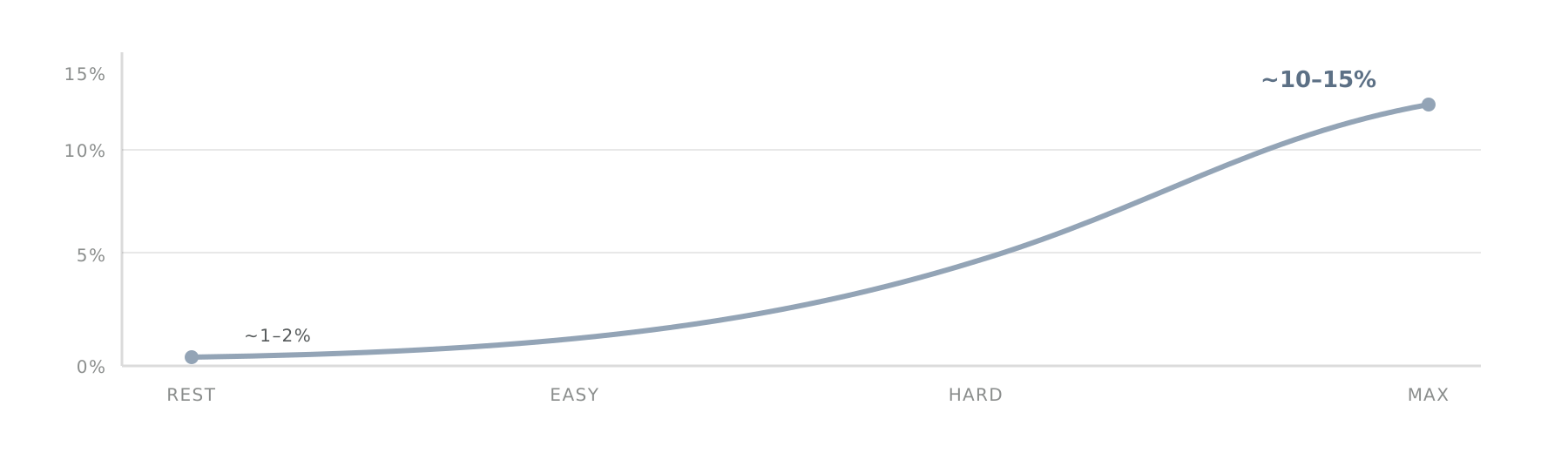
The breathing tax is not flat. At rest it is a rounding error. Near maximal effort, the muscles that move air can claim a tenth or more of all the oxygen you are using, and a large share of the final increment as you approach your limit. An inefficient breather pays more of this tax, sooner.
That is just the metabolic cost. There is a second, sharper mechanism, and it is the closest thing to a literal ceiling in this whole subject. When your breathing muscles start to fatigue during hard, sustained effort, they send distress signals up to the brain. The body's response is protective and ruthless: it clamps down on blood flow to your working limbs and redirects it to keep the breathing muscles alive, because you can survive tired legs but not a failed diaphragm. Physiologists call it the respiratory muscle metaboreflex.3
The experiments that pinned it down are elegant and a little brutal. When researchers artificially unloaded trained cyclists' breathing muscles at high intensity, endurance improved by around fourteen percent. When they added load, making the breathing muscles work harder, endurance dropped by about fifteen percent. Same legs, same heart, same lungs. The only thing that changed was how hard the breathing muscles had to work, and it moved time-to-exhaustion by nearly thirty percent between the two conditions. Crucially, this reflex only switches on above a threshold of hard breathing work. It is not taxing your easy jog. It is deciding your last hard interval.
It helps to picture what that reflex is actually doing, because it sounds abstract until you feel it. Overworked breathing muscles release metabolic by-products, the same kind that pile up in any fatiguing muscle. Sensors inside those muscles fire a warning up to the brain, and the nervous system answers by tightening the blood vessels feeding your arms and legs, quietly rationing their supply to guarantee the breathing muscles keep going. You do not experience it as a breathing problem. You experience it as legs that suddenly feel heavier than your effort should warrant, a wall you hit without quite understanding why. An efficient breather, moving air with less muscular fuss, simply reaches that wall later, or on a good enough day, not at all.
This is what "breathing economy" really buys you. Not more oxygen. A smoother, cheaper breath keeps the metabolic bill lower and keeps you further from the threshold where your own breathing muscles start stealing blood from your stride. It is the difference between a breath that costs you and a breath that gets out of the way.
The gas that runs the show is the one you exhale
Ask most people what drives the urge to breathe and they will say oxygen. They are wrong, and the correction is the key to this entire field. The overwhelming trigger to breathe is not a lack of oxygen. It is a rise in carbon dioxide. Sensors in your brainstem and arteries watch CO2 closely, and when it creeps up, they generate that mounting, undeniable air hunger. Hold your breath and the panic you feel is not your body running out of oxygen. It is CO2 knocking louder and louder on the door.
Carbon dioxide has an image problem. We think of it as waste. In fact it is a signalling molecule your body works hard to keep in a narrow band, and it does something genuinely useful at the tissue level. When blood reaches a hard-working muscle, the local CO2 and acidity there nudge your red blood cells to release their oxygen more readily, right where it is needed most. This is the Bohr effect, and it is real, precise, and automatic.4 Jack McMillan, a former professional footballer turned breathing coach who has run these assessments with thousands of athletes, describes the practical version:
"There's a term called the Bohr effect, where without the right amount of CO2 in the blood, oxygen will not be released as readily to the cells. We hold onto it more. So we need both."
On the record Jack McMillan · ex-professional footballer, breathing coach · alveos Art & Science of Breathing, E12
Here is where honesty matters, because this is exactly the point the internet overshoots. The Bohr effect is a local unloading mechanism, driven by the local conditions in a working muscle. It is not a lever you pull to flood your whole body with extra oxygen. You will see claims that training yourself to "tolerate more CO2" will dramatically boost oxygen delivery and transform your endurance. That overstates a real but modest, automatic, local phenomenon. Your arterial blood, remember, is already nearly full.
So why does CO2 tolerance matter at all? Not because it magically oxygenates you, but because your comfort with CO2 shapes how you breathe. If your system panics at the faintest rise in carbon dioxide, you over-breathe: you gulp more air than you need, your breathing becomes fast and shallow and effortful, and you spend energy fighting a threat that isn't there. A calmer relationship with CO2 tends to travel with slower, smoother, more economical breathing under load. It is less a performance booster than a regulation trait, and it happens to be measurable.
The trap is that over-breathing feeds itself. Breathe a little too much, a little too often, and you keep your carbon dioxide chronically on the low side, which leaves your sensors primed to sound the alarm at the faintest rise. That low threshold makes you breathe more, which keeps CO2 low, which keeps the threshold low, a loop that quietly installs itself and then feels like your normal. McMillan describes the way out in plainly physical terms: gentle, unforced breathing that lets you sit with a mild, comfortable air hunger, over time, "dampening the chemoreceptors so they can be nice and relaxed. Less is more." You are not building lung power. You are turning down an oversensitive alarm.
Which is a good moment to measure yours.
Take two or three easy, normal breaths. Then inhale gently through your nose until comfortably full, not a maximal gulp. Press Start and breathe out as slowly and smoothly as you can through pursed lips. Press Stop the moment your lungs feel empty or you need to breathe in.
An interactive version of this carbon-dioxide comfort check, with a timer, is at the bottom of this guide, just above the footer.
This is a slow exhale, never a breath-hold. Do it sitting down. Never near water or while driving. Stop at once if you feel dizzy or lightheaded, that is your cue to breathe normally. The bands below come from Brian Mackenzie / SHIFT and are a rough guide only. The real signal is your own number over time, measured the same way, not where you sit against anyone else. This is a self-awareness check, not a medical test or a measure of anxiety.
A longer, calmer exhale generally reflects a more relaxed relationship with CO2. Andy Galpin's lab helped validate a version of this test; he uses the result to pick a starting pace for slow breathing, shorter exhales suggest starting gently, longer ones mean you can go slower still.
Whatever your number, treat it the way you would a single morning weigh-in: one data point, noisy, only meaningful as a trend. McMillan runs the breath-hold version of this check in team rooms, and the results are humbling. Working with a Premier League club's under-eighteens, he found the squad averaged a sixteen-second comfortable breath-hold, with the room ranging from five seconds to thirty. These are some of the fittest young people in the country. As he says, it makes sense once you ask the obvious question: "How would they ever be good at holding onto CO2? It's never been trained."
Your nose and your mouth are gears, not a moral choice
No debate in breathing is more overheated than nose versus mouth. One camp tapes their mouth shut and treats nasal breathing as a near-spiritual discipline; the other rolls its eyes. The useful truth sits between them, and two people who arrived at it from completely different directions, an academic physiologist and an ex-footballer, reached for the exact same metaphor: gears.
McMillan lays it out simply. "No nose, gear one. Nose and mouth, gear two. Mouth and mouth, gear three. What time in your life do you actually need gear three?" Galpin, describing the same system, is more precise about the mechanics: gear one is a slow, deliberate nasal rhythm, a two-to-three-second breath in and out through the nose; gear two is nasal breathing at whatever rate the effort demands; and only in the top gears do you add the mouth, then breathe through it entirely. The point of the framing is that each gear is correct in its place. Nobody criticises a car for using third gear on the motorway.
Figure 2 · The gears of breathing

Change gear with the terrain. The mistake is not using the mouth. The mistake is living in third gear, mouth-breathing at a desk or in bed when the body is barely working. Match the gear to the load.
Why prefer the nose at all when you can? The nose filters, warms and humidifies incoming air, and it adds a small dose of nitric oxide, a gas made in the sinuses that helps match blood flow to the parts of the lung doing the work.5 Nasal breathing also tends to be slower and more economical. What it does not do, despite the marketing, is meaningfully raise your VO2 max or turn you into a better athlete on its own. When researchers put trained athletes through the same hard sessions breathing nasally versus through the mouth, performance came out roughly the same, with nasal breathing showing better efficiency, not better ceilings.6
Fair to say. Breathing through your nose at rest and in easy training is a sensible default. It is more economical, it conditions the air, and it keeps you out of the over-breathing habit. Gear down whenever the effort lets you.
Overstated. That forcing nasal-only breathing "caps" your intensity or boosts performance. In direct tests it did neither, people still pushed past their intended easy pace. The nose is a useful gauge of effort, not a hard governor, and not a shortcut to fitness.
McMillan's most practical note is about the gear you are in right now, reading this. "If you're sat at a desk, your mouth should be closed, breathing low, slow and deep, tongue gently on the roof of your mouth." Third gear at rest is the giveaway of a system stuck in the wrong ratio, spending energy it does not need to spend, all day long.
When breathlessness means something, and when it doesn't
Here is the hidden minority we promised to return to, and it needs a clinician's care, which is why Dr Vyas reviewed this section. Start with the most common misreading of all: that feeling out of breath means you are unfit. Dr Vyas is blunt about it. "Breathlessness is normal. Everyone gets breathless." Finish a hard effort and of course you are gasping; that is the system working. The question that matters is a different one.
"The thing we always look at is whether your breathlessness is disproportionate to your physicality. If you feel you could keep going, but it's your breathing that stops you, that's something worth assessing."
On the record Dr Aashish Vyas · respiratory physician
That distinction, legs say go but breathing says stop, is the signal worth noticing. Most of the time the cause is benign and trainable: you are detrained, or your breathing pattern has drifted into something inefficient. Sometimes it is not, and this is where the popular wisdom fails people. We tend to assume that a real breathing problem announces itself with a wheeze. It often doesn't. In the most severe asthma attacks, Dr Vyas points out, the wheeze can vanish entirely, because the airways are too tight to make the sound. He calls the quiet, hard-to-detect version the silent zone. Plenty of people, including him, carry a mild airway limitation for years with no wheeze at all, just a sense of working harder than everyone else and never knowing why.
There is also a category that is not about the lungs at all. In some people the breathing pattern itself has gone wrong, the coordination of the diaphragm, the timing, sometimes a voice box that narrows under load, and the machinery moves inefficiently even though the lungs are healthy. It is common, under-recognised, and often mistaken for asthma and treated with an inhaler that cannot fix it, because it is a skill problem, not an inflammation problem. It can be retrained, usually with a specialist respiratory speech and language therapist.
It helps to know what the machinery is supposed to do, because it makes the failures legible. A good breath is mostly the diaphragm's job: the big dome-shaped muscle beneath your lungs drops down, creating a vacuum that draws air in low and wide, while the airway above stays relaxed and open. Dr Vyas describes the vocal cords as the door to the lungs, a door that should sit wide during a breath. When that door narrows under stress, or the diaphragm and the ribcage stop moving in sync, you get the unmistakable sense of fighting for air even though the lungs themselves are perfectly healthy. For the rest of us the lesson is simpler than the anatomy: efficient breathing is low, quiet, and coordinated, and almost every inefficient pattern is some version of high, forced, and out of sequence.
Where the line is. This guide is education, not medical advice, and alveos makes wellness tools, not diagnostic ones. If your breathlessness is genuinely disproportionate to your effort, if it comes on at rest, or with chest pain, or if you suspect a sleep-breathing disorder, see a qualified clinician rather than an app or a breathing coach. Persistent, unexplained breathlessness is a reason to get assessed, not to push through.
The reason this matters for everyone, not just the diagnosable few, is what it reveals about the limits of feel. These footballers had elite engines and no symptoms. Their own perception told them nothing. Which raises the question the rest of this guide turns on: if you cannot always feel the ceiling, how would you ever know it is there?
Recovery is a breathing skill, and almost no one practises it
Everything so far has been about the effort itself. But the largest, most accessible gain for most people is not in the effort at all. It is in the minutes and hours afterward, and it is where McMillan sees the same failure again and again.
An athlete finishes a hard session or a match. Their body has spent the last ninety minutes in high gear, sympathetic system firing, breathing fast and hard. And then, McMillan says, the problem: "They continuously breathe like they are still on the pitch. They haven't dampened their stress response." The whistle blew, but the breathing didn't get the message. The body stays wound up, into the evening, into the night, and the single most valuable recovery window, the sleep after a hard effort, gets spent half-activated. The training load went in. The adaptation, which happens during recovery, gets shortchanged.
This is the part almost nobody is taught, and it is genuinely trainable, because the exhale is a lever on the nervous system. Breathing in gently nudges you toward activation; breathing out, slowly, nudges you toward recovery. It is not a magic switch, but it is a real and usable bias. Galpin's prescription is refreshingly concrete: in the first few minutes after training, lie on your back and spend three to ten minutes deliberately breathing with long, slow exhales, letting the body shift out of high gear. You are not adding stress. You are closing the session properly.
A fast reset that has real evidence. For an in-the-moment down-shift, the best-studied technique is the physiological sigh: two inhales through the nose, the second a short top-up sip, followed by a long, slow exhale through the mouth. In a controlled trial, five minutes a day of this pattern lowered arousal and improved mood more than an equal dose of mindfulness.7 One to three rounds is enough to take the edge off. It is the single most reliable "come down" tool on this list, and it costs about twenty seconds.
The same logic runs straight into sleep, which is where breathing does its quietest and most important work. Mouth-breathing through the night is linked with more disrupted, less restorative sleep, and the giveaway is the one McMillan points to: you wake up with a completely dry mouth. The fix is not universal, and he is careful about it: mouth tape helps some people and is wrong for others, and anyone who might have sleep apnea should not tape at all, because the mouth is their emergency airway. The principle underneath is simple though. The breath you most want to be calm, nasal and quiet is the one you are least able to supervise, because you are asleep for it.
And the timing compounds it. The most valuable recovery of all is the sleep on the night after your hardest effort, which is exactly the night an under-regulated nervous system is least likely to deliver. McMillan watches athletes sleep worst after their biggest games, still wired from a match that ended hours before, and the same trap catches anyone dragged across time zones on red-eye flights or wound up by late-night screens. The breathing you bring to those hours, or fail to, is quietly deciding how much of the training actually becomes adaptation. The effort is the easy part. The recovery is where it is kept or lost.
The same ceiling sits over your desk
If you have read this far assuming it is a guide for people who play sport for a living, here is the pivot. Almost none of it depends on being an athlete, because the system underneath does not know or care what you do for work. McMillan, who now coaches executives as often as footballers, puts it with a shrug: "The body doesn't know whether it's a stressful meeting or a football match. The nervous system doesn't know the difference. It's the same response."
Look again at what actually improved for those screened footballers. Not their top speed. Their capacity to make better decisions late in the game, when they were tired. That is a cognitive result, and it maps almost exactly onto the thing a knowledge worker most wants to protect: clear judgement in the third meeting of the afternoon, the presentation after a bad night, the hard call at the end of a long week. The eighty-fifth minute and the four o'clock slump are the same physiology wearing different clothes.
Breathing turns out to be a usable lever on that in-the-moment state, and the reason is mechanical, not mystical. Under acute pressure, breathing quickens and shallows, arousal climbs, and attention narrows to a tunnel. A few deliberate breaths, weighted toward a slow exhale, gently push the other way and widen the aperture again. This will not erase a real threat or undo a genuinely hard day, and it is emphatically not instant calm. What it does is help you intervene a little earlier and regulate a little more effectively, at the precise moments that decide outcomes.
It is why McMillan spends so much of his time teaching athletes to reset after a mistake. A footballer who misplaces a pass, a tennis player who nets an easy shot, a founder who fumbles a question, all share one failure mode: the error spikes arousal, the next decision degrades, and a single mistake becomes a run of them. A trained breath in the gap is a way to close that loop, drop the arousal, and start the next moment clean. He rehearses it under deliberately stressful conditions so the tool is actually there when it counts, which is the honest catch: it is a skill, not a switch, and it has to be practised in the calm to be available in the storm.
None of which asks you to breathe one prescribed way. The same principle that governs the pitch governs the open-plan office: match the breath to the moment, notice when you are stuck in the wrong gear, and reach for the exhale when you need to come down. The hard part, as always, is the noticing, because the wrong gear feels perfectly normal from the inside.
What actually earns its place, and what is mostly hype
The breathing-for-performance world sells everything with equal confidence. The honest picture has a lot more texture. Some practices are well-supported, some are plausible with real caveats, and some are popular mainly because they are memorable. Here is the same toolkit, sorted by how much weight the evidence can carry.
Practice | What it is | Best for | Evidence |
|---|---|---|---|
Down-regulation breathinglong exhales, physiological sigh | Slow, exhale-emphasised breathing after effort and before sleep to shift out of high gear. | recovery, sleep | Well-supported |
Gearing nose → mouthnasal by default | Nasal breathing at rest and easy effort; mouth only when the intensity truly needs it. | economy, pacing | Well-supported (economy) |
CO2-comfort workslow exhales, gentle holds | Gradually getting comfortable with mild air hunger so you over-breathe less under load. | self-regulation | Awareness tool, not a booster |
Inspiratory muscle trainingresistance breathing devices | Training the diaphragm against resistance so breathing muscles fatigue later. | endurance (some) | Mixed · small, bigger if less-fit |
Breath-hold / CO2 "training"for performance gains | Repeated breath-holds aiming to raise capacity or race times. | awareness | Weak for performance |
Cyclic hyperventilationWim Hof-style rounds | Rounds of fast, full breaths and holds. An activating practice, not a recovery one. | arousal, cold | Use with caution |
How to read this. "Well-supported" means several controlled studies point the same way. "Mixed" means real but small and inconsistent. The rest are reasonable to explore, but should not be sold as proven performance boosters.
The two that earn the top grade
Down-regulation is first for a reason: the mechanism is sound, the recovery and sleep payoff is where most people have the most to gain, and the physiological sigh in particular has a proper trial behind it. If you take one thing from this guide, make it the deliberate exhale-focused wind-down after hard efforts and before bed. Gearing your breathing, nasal by default and dropping to the mouth only when you truly need it, earns its place on economy: it lowers the breathing tax and keeps you out of the all-day third-gear habit. Neither promises a bigger engine. Both make the engine you have run cleaner.
Reasonable, with the volume turned down
CO2-comfort work is worth doing as a self-regulation and awareness practice, the thing that stops you over-breathing under stress, but not because it floods you with oxygen. Inspiratory muscle training has genuine but modest support: meta-analysis finds a small average endurance benefit that is larger in less-fit people and tends to shrink toward nothing in already-elite athletes, with VO2 max usually unchanged.8 In other words, the people most likely to buy the device are the people it helps least. That is worth knowing before you spend money on it.
Handle with care
Cyclic hyperventilation, the fast-breathing-and-holds family made famous by Wim Hof, is an activating practice, not a calming one, and it carries a specific, non-negotiable hazard: never do it in or near water, or while driving, because the breath-holds can cause blackout. McMillan, who trained in intensive breathwork himself, is unusually candid about the whole category: "Breathing techniques can be dangerous, and we don't address that enough." He watched people at an intensive week go from stressed to more stressed, sleeping three hours a night, because the practice was too much for their nervous systems. Intensity is not the same as benefit.
Which points at the throughline of every honest voice in this field. Both McMillan and the coach Brian Mackenzie, who has spent a career on breathing for athletes, land in the same place, and it is the opposite of a one-size protocol. There is no single correct breath. As McMillan puts it, horses for courses, a different technique for a different person on a different day. The goal is not to obey a rule. It is to build enough awareness of your own breathing to choose well, which is a great deal easier when you can actually see it.
You cannot feel the ceiling, but you can measure the signal
The uncomfortable thread running through this whole guide is that feel is an unreliable narrator. Elite athletes with a real limitation felt nothing. People over-breathe at their desks without noticing. The wound-up post-training night feels, from the inside, like a normal night. If the most consequential parts of your breathing are the ones you cannot sense, then the honest path forward is not to try harder to feel them. It is to measure them.
The good news is that breathing carries a few signals that are genuinely readable. The most robust is your respiratory rate at rest, especially overnight. Within a single person, it is remarkably stable night to night, which is exactly what makes a deviation informative. When your resting breathing rate jumps a few breaths above your own baseline, it is often an early flag that something has changed, an oncoming illness, an incomplete recovery, accumulated load. Wearable studies have shown nocturnal respiratory rate rising a day or two before people felt ill, precisely because that baseline is normally so steady.9
Breathing rate is most powerful read against its companions, not alone. Paired with something like heart-rate variability, a rising resting breath rate helps separate genuine under-recovery from a bad night in a warm room. And the after-effort version is just as telling: how quickly your breathing settles back toward baseline once a hard session ends is a readable sign of whether you actually down-shifted or stayed stuck in high gear. These are the measurements that turn the abstract idea of a hidden ceiling into something you can watch move week to week.
Fair to say. A sustained rise in your own resting or overnight breathing rate is a meaningful personal signal, best read as a deviation from your baseline and alongside other measures like heart-rate variability.
Not fair to say. That any single breaths-per-minute number diagnoses illness, overtraining, or readiness. There is no universal threshold, the signal is one input among several, and using breathing-rate variability as a readiness score is still an emerging, lightly-studied idea. Treat it as a trend, not a verdict.
This is where the shape of the tool matters. Most wearables infer your breathing indirectly, estimating it from your pulse at the wrist. It is a clever estimate, but an estimate, and it captures little of the texture, the ratio of inhale to exhale, whether you are breathing through your nose or your mouth, the smoothness of the pattern, the slow drift of your baseline across a day. Dr Vyas, thinking about what it would actually take to make breathing visible, arrived at the same conclusion unprompted: "You need something on your chest, non-intrusive, that lets you be effective. I don't think you can do it through a wristwatch."
That is the specific gap alveos One is built to close. Not to diagnose anything, and not to read your mind, but to make a continuous, trainable signal visible where it has mostly been invisible: your resting breathing-rate baseline and how it drifts, the balance of your inhale and exhale, whether you are recovering after effort or staying stuck in high gear. It measures what other wearables can only infer. You take around twenty thousand breaths a day; the point is simply to let you finally see what they are telling you, and to nudge you, gently, at the moments that matter. The state is always inferred, never certain. The promise is a better window and a well-timed prompt, not a verdict.
A short, honest practice
Everything above reduces to a handful of instructions. Not a protocol to optimise. A place to begin, and to keep.
Gear down by default. Nose in, nose out, at rest and in easy effort, mouth closed at your desk and in bed. Save the mouth for the gears that genuinely need it. This is the cheapest economy gain there is.
Close every hard effort deliberately. In the first few minutes after training, and again before sleep, spend a few minutes on long, slow exhales. For an acute spike, use a physiological sigh: two breaths in, one long breath out. This is the half almost no one trains, and where most people have the most to gain.
Get gently comfortable with air hunger. Slow, smooth exhales and easy pauses, never forced, build a calmer relationship with CO2, so you over-breathe less when it counts. Track your comfort check as a personal trend, not a score to beat.
Protect the breath you can't supervise. Aim for quiet, nasal breathing overnight. If you wake with a bone-dry mouth, that is a signal worth acting on. Get real breathlessness assessed rather than pushing through it.
Watch your own baseline. A resting or overnight breathing rate that drifts up from your normal is worth noticing. The value is in your trend, measured the same way over time.
The one-screen version
Even elite engines can be quietly capped by a breathing limit they cannot feel. Feel is an unreliable narrator.
For most healthy people, oxygen getting in is not the bottleneck. Your blood is already nearly full, and the heart, not the lungs, sets the ceiling.
Breathing has a real energy cost that climbs steeply near your limit, and tired breathing muscles can trigger a reflex that steals blood from your legs. Economy, not extra oxygen, is the prize.
CO2, not oxygen, drives the urge to breathe. Comfort with it makes you breathe more calmly under load; it does not magically boost oxygen delivery.
Nose and mouth are gears. Nasal by default for economy, mouth when the effort demands it. Forcing nasal-only neither caps intensity nor builds fitness.
The biggest accessible gain is recovery: deliberately down-regulating with long exhales after effort and before sleep, the half almost nobody trains.
Grade the techniques honestly, and remember there is no single correct breath. The point is awareness, which is far easier when you can measure it.
Sources & further reading
Bassett, D. R., & Howley, E. T. (2000). "Limiting factors for maximum oxygen uptake and determinants of endurance performance." Medicine & Science in Sports & Exercise, 32(1), 70–84.
Aaron, E. A., Seow, K. C., Johnson, B. D., & Dempsey, J. A. (1992). "Oxygen cost of exercise hyperpnea: implications for performance." Journal of Applied Physiology, 72(5), 1818–1825.
Harms, C. A., et al. (1997; 2000). Respiratory muscle work and limb blood flow / time-to-exhaustion in trained cyclists. Journal of Applied Physiology, 82(5) & 89(1).
Oxygen–hemoglobin dissociation (Bohr effect). StatPearls, "Physiology, Oxyhemoglobin Dissociation Curve" and "Carbon Dioxide Dissociation." NCBI Bookshelf.
Lundberg, J. O., et al. (1994–2008). Nasal / paranasal nitric oxide and ventilation–perfusion matching. Acta Physiologica Scandinavica and later reviews.
Bergqvist, J., et al. (2025) and Dallam, G., et al. (2018). Nasal vs oral/oronasal breathing in trained runners: comparable VO2max and performance, improved ventilatory efficiency with nasal.
Balban, M. Y., et al. (2023). "Brief structured respiration practices enhance mood and reduce physiological arousal." Cell Reports Medicine, 4(1), 100895.
Illi, S. K., et al. (2012). "Effect of respiratory muscle training on exercise performance in healthy individuals: a systematic review and meta-analysis." Sports Medicine, 42(8), 707–724.
Miller, D. J., et al. (2020) and Natarajan, A., et al. (2021). Wearable nocturnal respiratory rate as an early signal of illness onset. PLOS ONE and npj Digital Medicine.
Expert interviews. Dr Aashish Vyas (respiratory physician) and Jack McMillan (ex-professional footballer, functional-breathing coach), alveos Art & Science of Breathing, episodes 1 and 12. Andy Galpin (Huberman Lab guest series) and Brian Mackenzie / SHIFT on breathing for performance and the carbon-dioxide comfort check.
This guide is for education and general wellness. It is not medical advice, diagnosis, or treatment, and alveos One is a wellness device, not a medical one. Nothing here is intended to diagnose, treat, cure, or prevent any condition. The carbon-dioxide comfort check is a self-awareness tool, not a medical test. If you have concerns about your breathing, your recovery, or your health, consult a qualified healthcare professional.
Sit down and breathe normally for a few breaths. Take an easy, normal inhale through the nose. Then exhale as slowly, quietly and evenly as you can. Press Start as you begin the exhale, and Stop the moment you need to inhale again. No straining, no forcing the last drops of air out.
This is a slow exhale, never a breath-hold. Do it sitting down. Never near water or while driving. Stop at once if you feel dizzy or lightheaded; that is your cue to breathe normally. The bands come from Brian Mackenzie / SHIFT and are a rough guide only. The real signal is your own number over time, measured the same way, not where you sit against anyone else. This is a self-awareness check, not a medical test or a measure of anxiety.